Software Architecture
April 4, 2026
10 min read

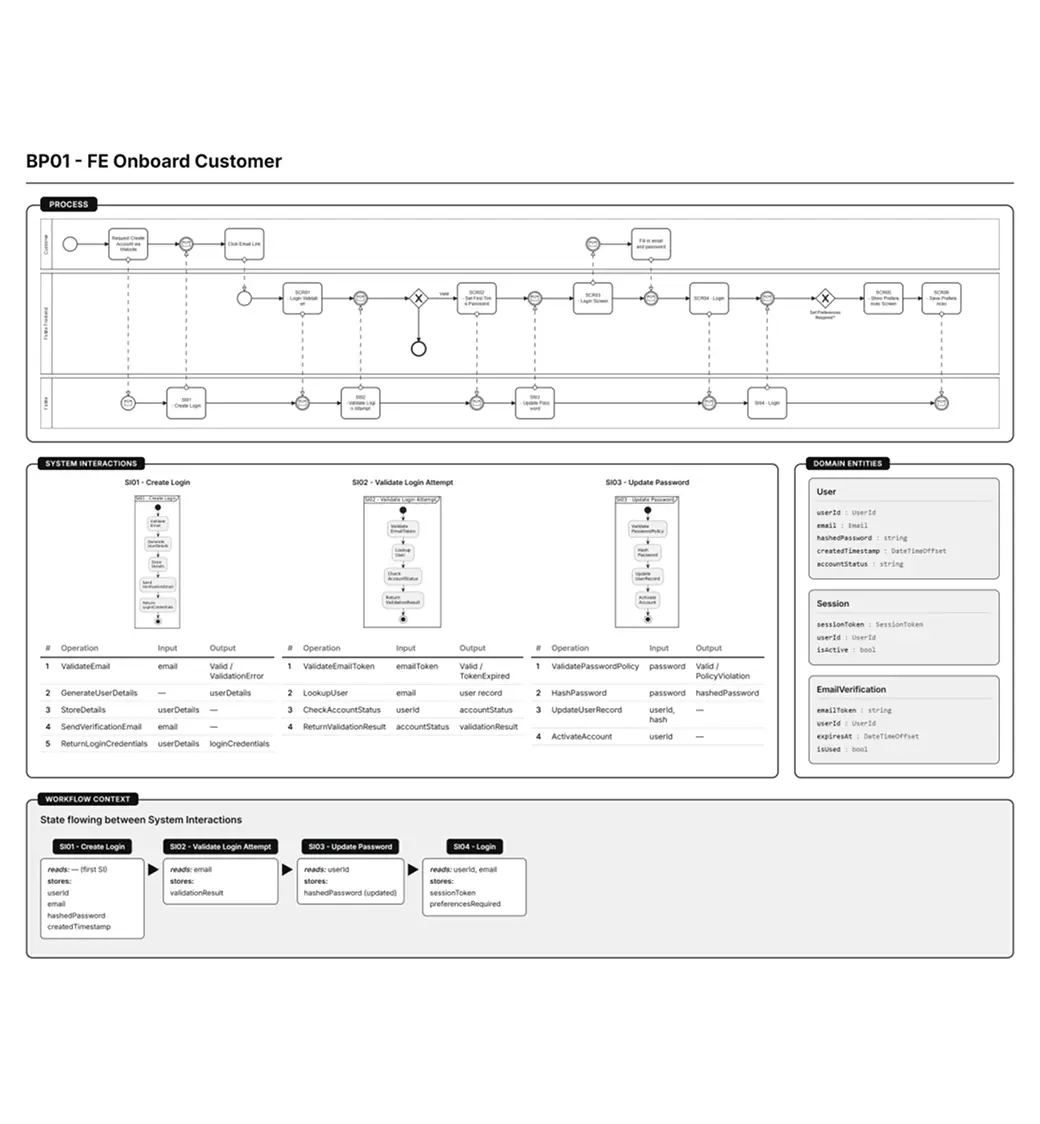

You are looking at one business process — onboarding a customer — broken down into four layers: process flow, system interactions, domain entities, and workflow context.
No wall of text. No requirements document you need to scroll through for twenty minutes. Four views, each comprehensible on its own, each serving a different purpose.
Now imagine describing all of this in prose alone (specs).
Every gateway, every operation, every entity, every state transition — captured in natural language. Requirement on top of requirement. Constraint referencing constraint. Exception on top of exception.
You would not end up with clarity. You would end up with a legal document.
This is not a new problem. Look at law.
Legal systems are built entirely in language: rules, amendments, exceptions, interpretations, cross-references, precedents. After centuries of refinement, we still need armies of specialists just to navigate what it all means. Nobody holds the full picture. Nobody can.
That is not a failure of law. It is a property of language at scale.
Natural language compounds. Layer by layer, sentence by sentence, it grows until comprehension becomes impossible without specialization.
So when the AI era promises — "just describe what you want in natural language, and let the machine build it" — we should pause.
Because specifications follow the same path. And at system scale, specs do not create clarity. They create a legal system for your software.
The real issue is not that large systems are hard to read. It is that they become hard to reason about.
We have always known this. A thousand-line code file is hard to comprehend. A hundred-thousand-line codebase is nearly impossible to hold in your head. That is why software engineering invented modularity, abstractions, layers, and service boundaries. Not because we enjoy complexity — because human cognition has limits.
AI does not remove those limits. It raises the speed.
And speed without structure does not reduce chaos. It amplifies it.
That difference is everything.
A specification tells you what needs to exist, what should happen, what constraints apply. But a model gives you the structure needed to reason about the system as a whole. Boundaries, relationships, responsibilities, flows, trade-offs — visible at a glance.
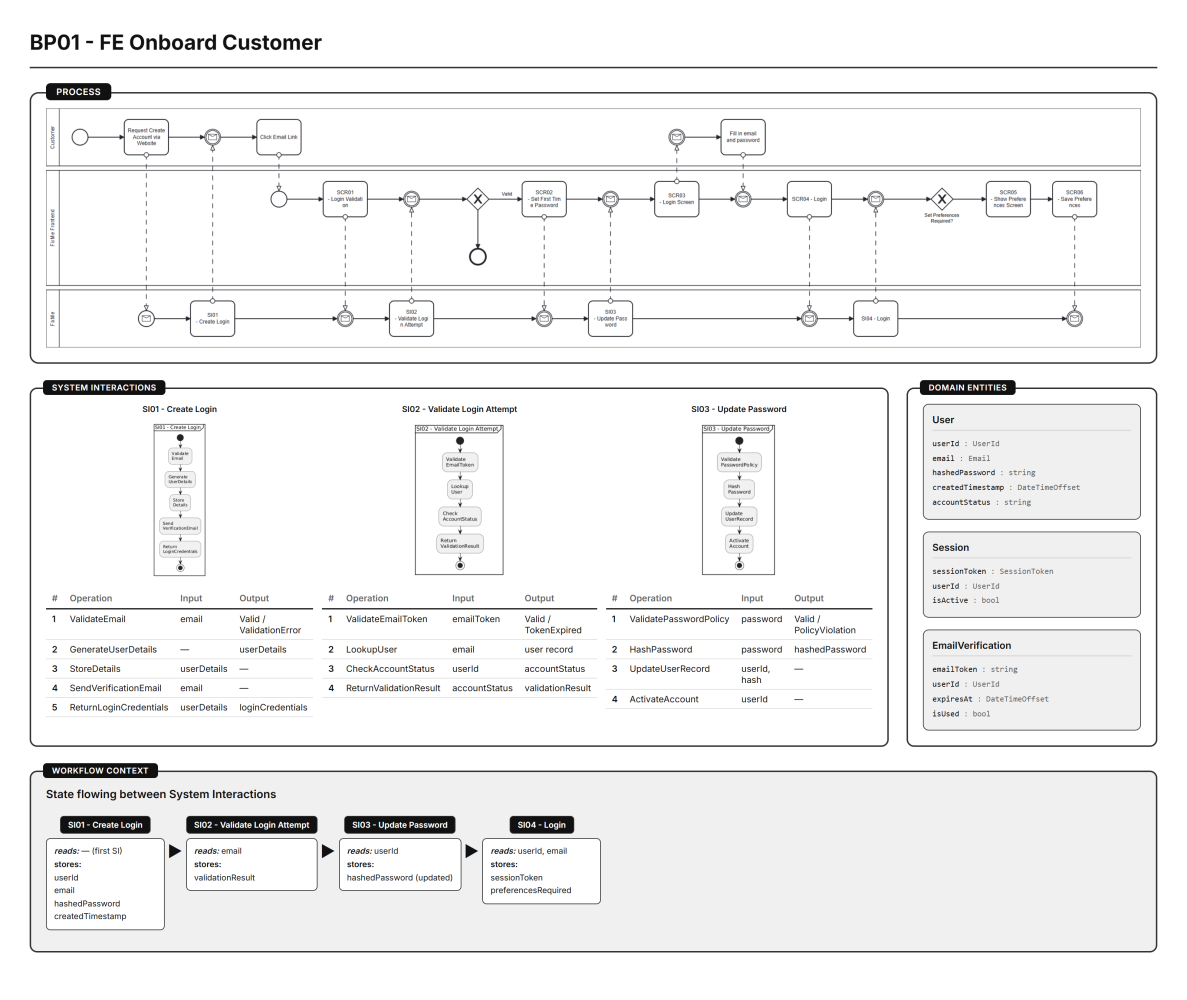
Look at the infographic again. The process layer shows what happens. The system interactions show how services collaborate. The domain entities show what the system knows. The workflow context shows how state flows between steps.
Each layer is comprehensible on its own terms. Together, they give you a map of the system — not a description of every blade of grass.
This is information layering. Visual models first, then specs scoped and anchored to structure. Not the other way around.
A model is not just a cleaner description. It is a problem-solving tool. It reduces cognitive load. It lets teams isolate concerns, challenge assumptions, and make decisions without drowning in detail.
Without models, complexity does not just become hard to read. It becomes hard to solve.
The AI era will create a sharp split.
Teams that rely only on specs will create volume. They will move fast at the start — generating requirements, features, and code at unprecedented speed. But eventually, the accumulated context will overwhelm them. Nobody will hold the full picture. Every change will require re-reading, re-interpreting, and re-validating prose that was never designed to scale.
Teams that know how to model will create control. They will have the structure needed to keep solving problems as complexity grows. Not because they write fewer specs — but because their specs live within a framework that makes the system governable.
Speed favors the first group early. Structure favors the second group permanently.
AI raises the ceiling on what a small team can produce. That is genuinely exciting. But it does not reduce the need for architecture. It increases the need for people who can shape systems before those systems explode into volume.
The purpose of modeling is not to create more artifacts. The purpose is to make complex problems solvable.
That is what we teach in the Master Builder Clinic — how to move from prose to structure. From requirements and specifications to models that remain understandable, governable, and solvable as complexity grows.
Because in an AI-accelerated world, the winners will not be the people who can write the most specs.
They will be the people who can turn complexity into structure.
Interested in the Master Builder Clinic?